‘What intrigued me the most was that it was a true story’: Talha Chahour on ‘Rutba’
Actor discusses character’s moral struggles, his physical transformation and working with Hiba Bukhari in the drama
“When I read it, I found it interesting. What intrigued me the most was that it was a true story,” says actor Talha Chahour, explaining what drew him to his latest drama, Rutba.
In an interview with Something Haute, the actor opened up about the real-life events behind the drama, revealing that its story and characters were inspired by actual people and circumstances. It was this connection with reality that made the project particularly compelling for him.
“When I got offered this, I was very excited,” he recalled, adding that his interest grew further after reading the script and learning about the people whose experiences had informed the narrative. “The characters are also a real part of the story. Then I read about those people and their lives, and then I made my character,” he said.
However, Chahour was careful to distinguish between the real individuals and their fictional portrayals. “It is better that we don’t talk about the real people, but if we can discuss the character, it is not just about his story as an ASP,” he explained.
The actor revealed that he conducted his own research to understand the character, uncovering several accounts about his background in the process. “When I read about him, a lot of stories came to light,” he said.
At the centre of Rutba is ASP Hadi, a young, educated man who enters the police force with a sense of purpose but gradually finds himself confronted by the system’s darker realities.
For Chahour, Hadi’s journey is not simply about an officer navigating his professional responsibilities. It explores what happens when someone raised with strong values enters an environment where power, politics, moral corruption and money begin to challenge everything he believes in.
“ASP Hadi was not just an ASP; it was about a young, educated man and officer who comes into the system and how the system breaks him apart,” he said.
Explaining the central conflict, Chahour said Hadi’s pursuit of justice exposes him to power politics, moral compromises and financial interests, all of which threaten to derail his path.
He also reflected on the vulnerability of people who come from hardworking backgrounds and find themselves in unfamiliar environments. “People like him, with his background and upbringing, are known as hard workers, but when they go from one setting to another, it is sad to say that they fall apart,” he said.
The drama’s title, Rutba, which refers to dignity, honour or status, also carries a deeper significance for the actor. He believes attaining a position of authority is one thing, but understanding the responsibility that comes with it presents an entirely different challenge.
“It is easy to control it, but taking responsibility is important,” Chahour remarked, pointing to how people can become consumed by the privileges attached to their positions without recognising the difference they could make through their authority.
He also highlighted the moral accountability that comes with power, suggesting that people must eventually answer for how they have used the positions entrusted to them. For him, Hadi represents an individual whose integrity is constantly put to the test. “Hadi is a very challenging character because he represents the ultimate test of human integrity,” he said.
Yet, Hadi is not presented as an uncomplicated hero.
Chahour offered a glimpse into the character’s personal and emotional struggles, explaining that his upbringing and the sacrifices made by his family are important to understanding his journey. “What his family sacrificed for him and his studies, you can see that he has been through trauma and worries,” he said.
The actor also hinted at the challenges that emerge when a young man, previously sheltered by his upbringing and circumstances, is exposed to an unfamiliar social environment.
Recalling Hadi’s interest in teaching and his education in a co-educational setting, Chahour explained how the character’s transition into a different world brings experiences that test his judgement and personal relationships. “I feel that when a good man is exposed to a bad world with bad people, it does not always mean that he is weak, but it means that we see him struggle,” he said.
Rather than portraying Hadi as someone who always makes the right decisions, the drama allows audiences to see his vulnerabilities and mistakes. “Hadi’s journey will show a real human being who stumbles,” Chahour said.
Addressing Hadi’s questionable decisions, particularly in his relationship with Mahnoor, the actor was careful not to defend the character’s actions.
“I cannot justify his actions. They are wrong. If you have been in a relationship for eight years, how can you do wrong?” he said, adding that he viewed Hadi as a character separate from the conventional idea of a hero. “He is doing wrong. Let’s see what happens ahead,” he added.
Chahour’s comments suggest that Rutba seeks to explore not only institutional corruption but also the personal compromises and moral failures that can emerge when individuals are confronted with temptation and power.
The interview also touched on his experience working with Hiba Bukhari, who plays Mahnoor. Marking their first collaboration, the drama brought the two actors together on a set that Chahour described as particularly welcoming.
He credited the production’s collaborative environment and strong leadership for helping the cast develop an easy working relationship and convincing on-screen chemistry.
“When your set has such a good environment, you can make a good project and bond together well. You can create good chemistry, which the audience can see, and the stories look real,” he said.
Music also became another point of connection among the cast members.
Referring to his singing in the drama, including the song Alfaaz, Chahour said viewers had particularly enjoyed the music selection. “Even Hiba sings in the drama. We selected these songs, and credit goes to Haseeb bhai. People really enjoyed the selection of the songs,” he said.
Beyond the drama, Chahour shared his thoughts on the importance of constructive criticism within the television industry.
He believes reviews that engage with a production’s story, themes and performances can help actors and creators improve, regardless of whether the feedback is positive or negative. “We get to learn from those critiques. That is a learning process,” he said.
While acknowledging the importance of review culture, he distinguished between thoughtful criticism and reviews that simply seek attention. “The review culture is important for our industry and should exist, but I also believe that you should not take it to heart but to your head,” he remarked.
The actor also discussed the physical transformation he underwent for Hadi, explaining that his approach to acting extended beyond delivering dialogue and performing scenes.
For the role, he adopted a wardrobe of shalwar kameez and coats while making changes to his physical appearance. Chahour revealed that he weighed 65 kilograms during his previous drama, Jama Taqseem, before gaining eight kilograms for Hadi, bringing his weight to 73 kilograms.
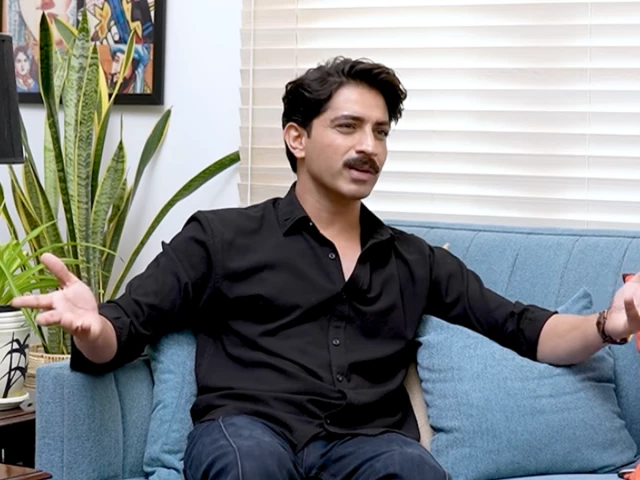
He also grew a real moustache for the character rather than relying on an artificial addition.
“I believe in transformation, not just acting,” he said, expressing disappointment that character-driven transformations did not always receive enough attention during the design process.
For Chahour, an actor’s appearance should reflect the requirements of a role rather than simply prioritising looking attractive on screen. “I don’t work to look good, but to look real,” he said.
Reflecting on his theatre experience, the actor explained that it had taught him to prioritise authenticity over conventional ideas of beauty. He believes performers must be willing to look different, even less conventionally attractive, if that is what a character demands.
This emphasis on transformation reflects Chahour’s theatrical background, where he developed an approach centred on inhabiting a role rather than merely performing it. The actor has steadily built his television career through projects including Jo Bichar Gaye, in which he portrayed Captain Farrukh, Wabaal, Jannat Se Aagay and Mannat Murad.
With his latest performance, Chahour takes on a character whose journey is rooted in real-life inspiration but whose struggles raise wider questions about integrity, authority and accountability. As he puts it, attaining rutba may be relatively easy; living up to the responsibility that comes with it is the real test.